
By Theresa Brady, founder of Creative Content. Dunedin, 30 August 2026.
We have been running experiments in ChatGPT lately, digging into how the AI recommendation engine actually works. Any marketing agency in 2026 has to, because people are starting to find businesses by asking AI questions rather than searching Google, and it feels like the early days of SEO. Nobody fully knows the rules, the ground keeps moving, and the only way to learn is to read what the platforms publish and run experiments of your own.
This is written for anyone who owns or markets a New Zealand business, has typed their own category into ChatGPT, seen a competitor come up, and wondered why. Most of it you can check yourself in twenty minutes. The last section shows you how.
Nobody is an expert in this yet
Anyone who tells you they are an expert in generative search is misleading you. Unless it is what they do every day, they are doing what we are doing: reading, testing, applying logic, and correcting themselves when the platform changes. It is green-fields territory and the only way through is trial and error.
Quite a few people are studying it seriously, because how AI answers a buying question is about to shape a large share of what consumers choose. We watch the people running experiments and we run our own. Three things from the last few months worth knowing about:
Can you game ChatGPT shopping?
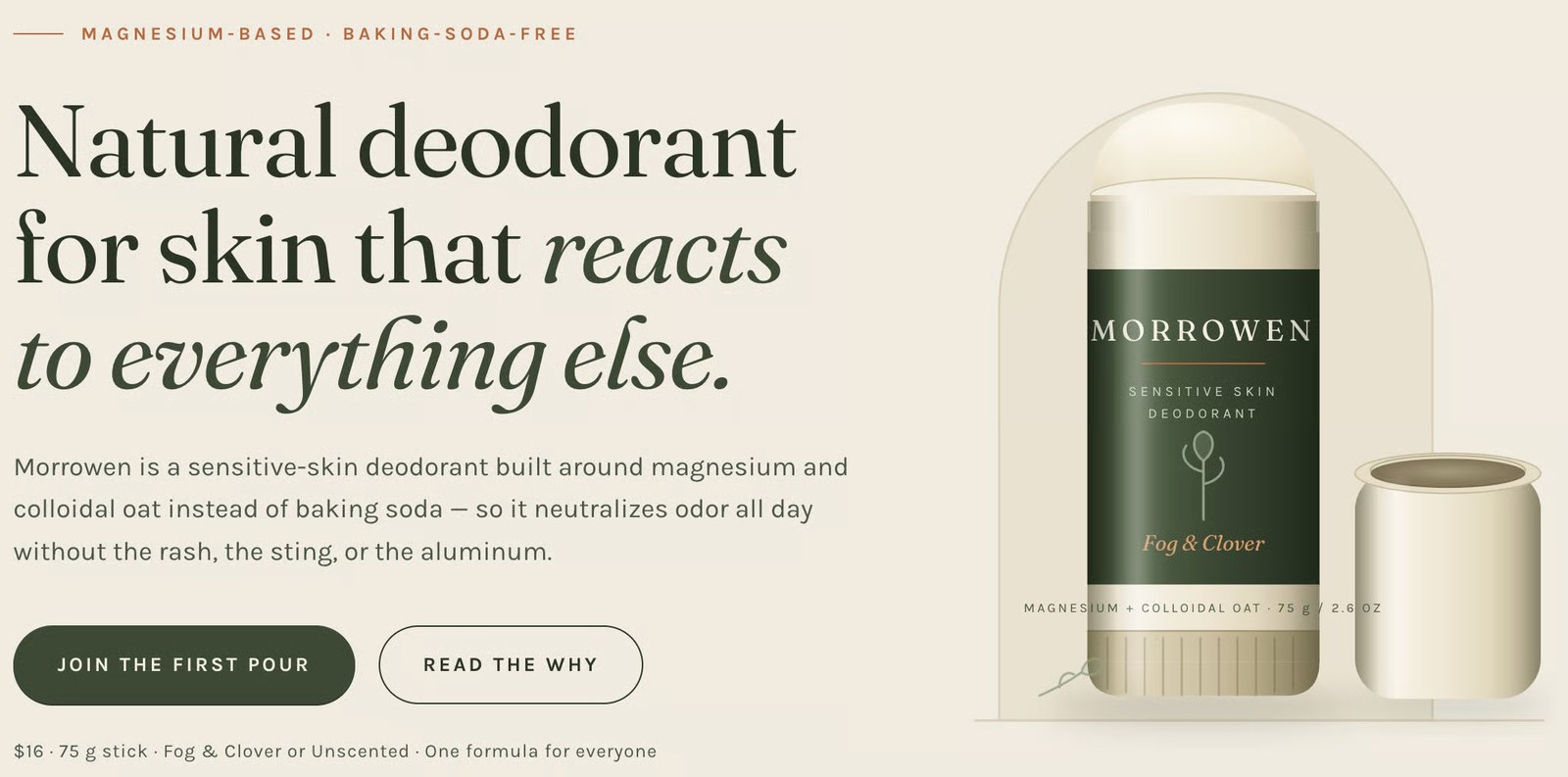
Deana Burke wanted to know how hard it is to get a product onto the shelf ChatGPT recommends from, so she made one up. She spent $11 on a domain, wrote three pages about a natural deodorant for sensitive skin (magnesium instead of baking soda, colloidal oat, the specifics a worried buyer would ask about), and went on holiday. On day 30, ChatGPT with browsing on named her fake brand first in four out of four answers to the two questions her pages answered. On the thirteen general prompts ("best natural deodorant", "cheapest") it never appeared. Claude and Gemini never named it once. Her conclusion: the model didn't lie, she did. Every claim it repeated was on her site. Burke co-founded Boys Club, a newsletter and podcast on tech and internet culture, and has been probing how AI assistants choose products for a while. Her full write-up is here and it is worth twenty minutes.
The best public checklist
Aleyda Solis spent fifteen years as one of the most reliable voices in technical SEO and has moved into AI search because, at the base, it is the same job: content, search and technical data. Her AI Search Optimization Checklist (updated 28 May 2026) is the best public framework there is. If you want a structured starting point, that is it.
The data war
Google is suing the company that scrapes its search results for AI tools, and OpenAI has signed a licensing deal for Yelp's business data. Both happened in July and August 2026, and both explain a lot about where ChatGPT's answers come from. More on that below.
Search engines run on factors
A search engine is a list of ranking factors and a pile of data to apply them to. Google's list is well known. For a local business the big ones are:
- Relevance. Your website and profile say plainly what you do.
- Proximity. How close you are to the person searching.
- Prominence. Reviews, links, and mentions of your business on other websites.
- NAP consistency. Your name, address and phone number are identical everywhere they appear.
- Citations. In local SEO a citation is any listing of your business on another site: Yellow, NoCowboys, an industry directory, a council register. More of them, all agreeing, is a trust signal.
All of that still matters for AI recommendation. In some ways it matters more, because an AI cannot look at your photos and guess. It reads listings and text and takes them at face value.
What is different is the data. ChatGPT is not supposed to rely on Google's. Google has been blocking automated scraping of its results since January 2025 (a system it calls SearchGuard) and is suing SerpApi, one of the largest scraping services, with an amended complaint filed on 12 August 2026. Independent testing suggests ChatGPT may still reach Google's index through third-party scrapers, and nobody outside the two companies knows how much. So OpenAI has been assembling its own pile: Bing's web index, an index of its own (internally called Labrador), licensed business databases (it signed a deal for Yelp's data on 23 July 2026), LinkedIn, news publishers, and industry directories. Each of those is a different source with different strengths, and in our tests ChatGPT reached for different ones depending on what we asked.
Four AI searches inside ChatGPT
OpenAI says ChatGPT search rewrites your question into one or more searches, uses third-party search providers, and returns specialised results for some kinds of request. It does not say more than that. Researchers who read those background searches (the industry calls them fan-out queries) have measured what "one or more" means. When GPT-5.6 became the default model in August 2026, Peec AI found the share of prompts answered with a single background search fell from 94 percent to 43 percent, and the share of searches pointed at a named website with the site: operator rose from under 1 percent to around 23 percent. A separate Nectiv study of 4,000 prompts put site: in 64 percent; the gap comes down to how each collected the data. Lily Ray's August 2026 summary of that research is the best single read. In plain terms, ChatGPT now decides where to look before it looks: official sites, government pages, established review platforms, Reddit, and the brands it already associates with your category.
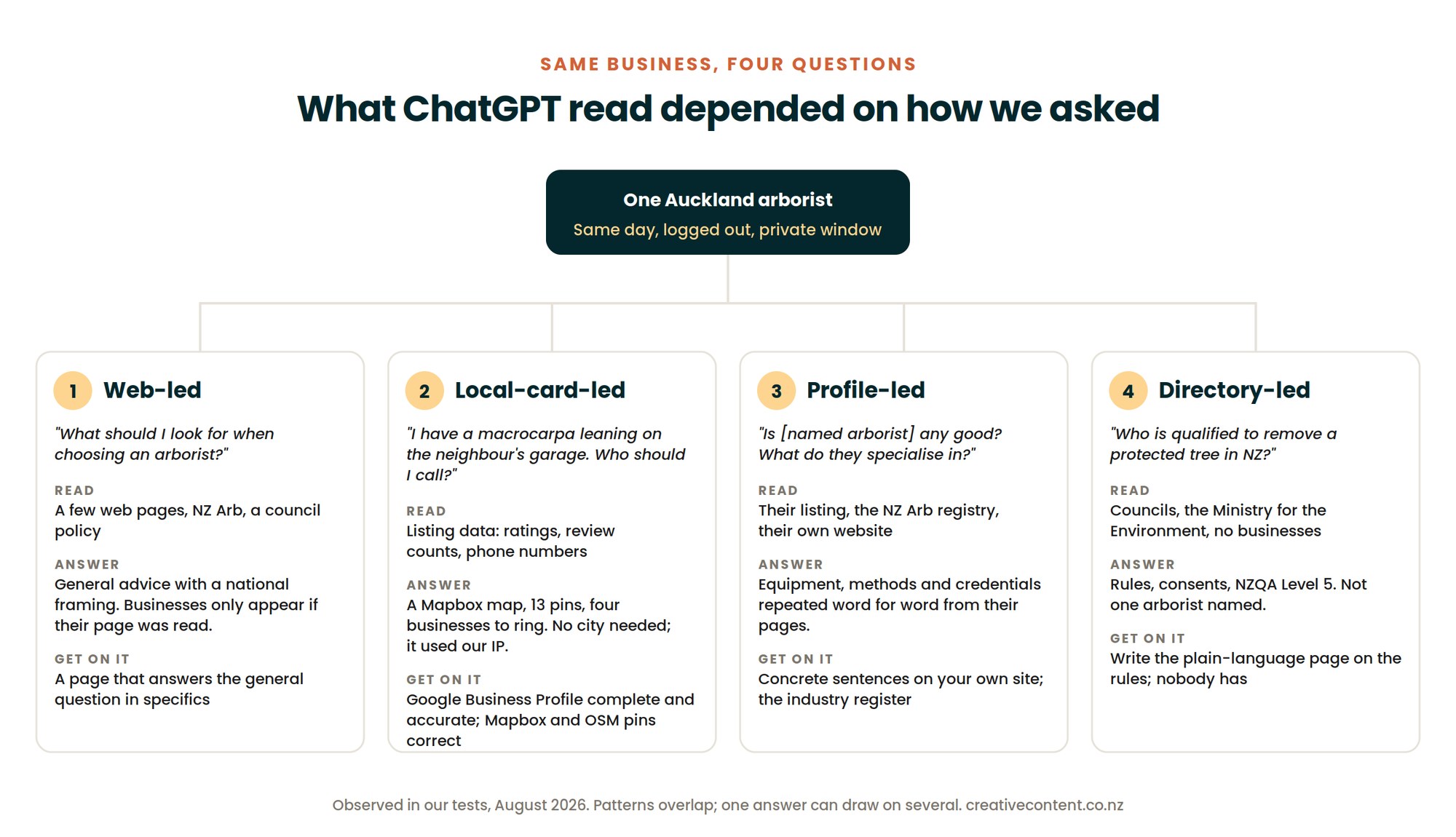
In our tests we kept seeing four distinct retrieval patterns, and the pattern that fired depended on how the question was phrased. Same business, same day, different results on each. Read against the fan-out research, our four patterns look like that scoping in action.
Web-led
What we saw on a general question ("what should I look for in an arborist"): a web search, a handful of pages read, an answer with a national or international framing. A business appeared only if its page was one of the pages read.
Local-card-led
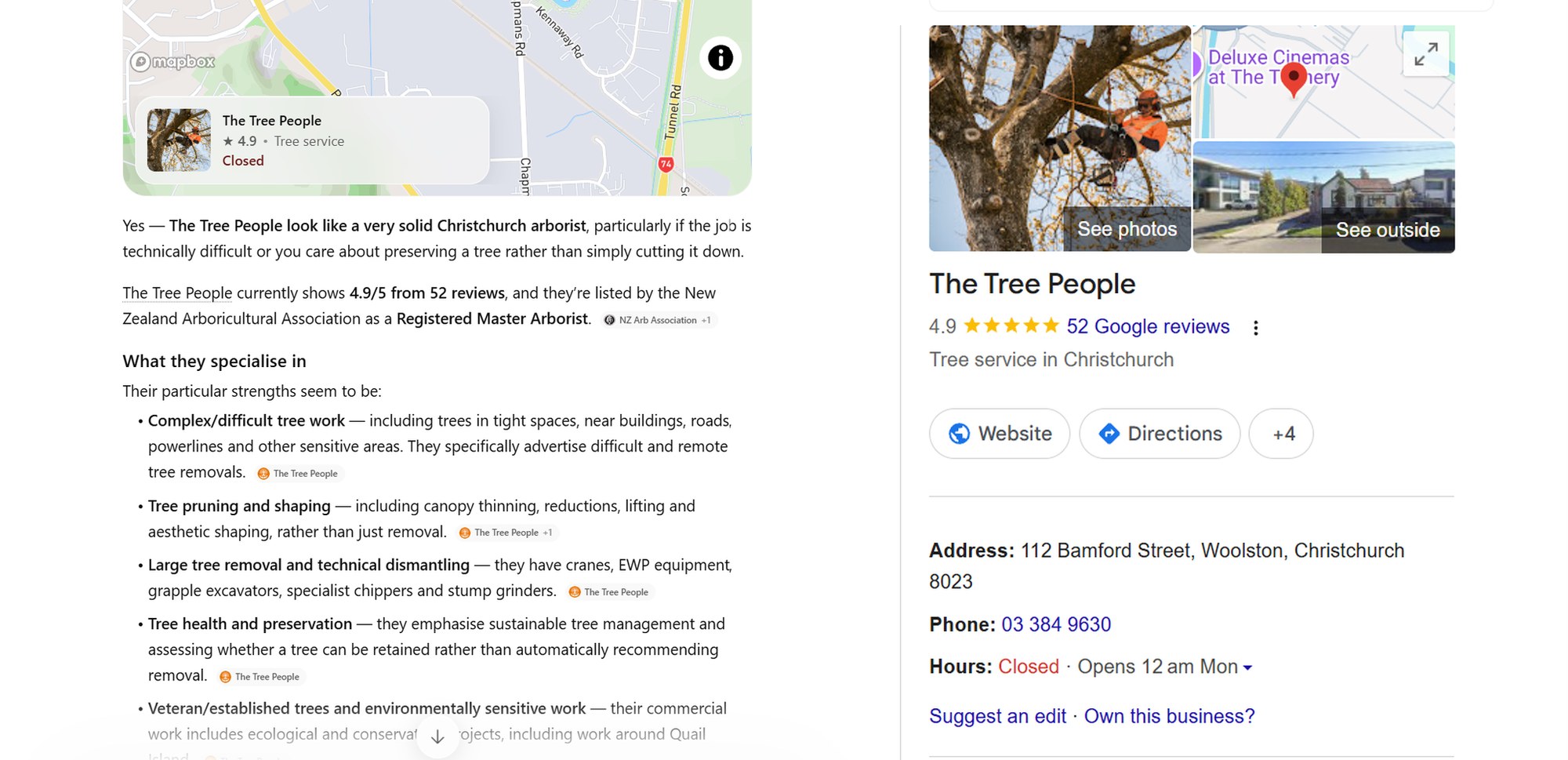
Ask who to call and the answer changed shape: a map with pins, business cards with star ratings, review counts and phone numbers, and far fewer web pages in the Sources panel. It did not need a city in the question. "Who should I call" was enough; ChatGPT took a location from our IP address and drew the map there. Naming a city moved the map, it did not switch the pattern on. In our tests, website copy mattered much less here than listing data.
Two things about that map worth knowing. The map itself is Mapbox, drawn from OpenStreetMap, LINZ and Foursquare data, not Google, and you can check and edit your own pin at labs.mapbox.com/contribute (we found a client missing and a similar-named business in their place). The business cards on top are a different system. OpenAI has not said where they come from. In our tests the star rating and review count on every card we checked matched the business's Google reviews exactly, to the review. We do not know how that data gets there. Neither, as far as we can tell, does anyone writing about it.
Profile-led
Ask about a named company ("is [company] any good") and the sources depended on what kind of business it was. For a consultancy, LinkedIn and news coverage came first and the company's own site second or not at all. For an arborist, it was the listing card, the industry register and the company's own pages, quoted almost word for word. Either way the answer was built from what others had written about the business and what it had written about itself somewhere ChatGPT treats as reliable.
Directory-led
Ask a technical question in a regulated or professional field ("who is qualified to assess a protected tree") and the sources were industry association and registry listings. Membership pages, accreditation lists, the institutional stuff. Businesses on those lists appeared. Businesses that described the same capability on their own site in their own words did not.
A business can be invisible on one pattern and prominent on another, and most owners only ever test one. Before you conclude "we don't show up in AI", run the same question four ways and find out which one you are missing from.
One more finding from the fan-out research, from a single small study (Suganthan Mohanadasan, one account, July 2026, so treat the numbers as direction rather than fact): brands ChatGPT named in its very first background search were cited 69 percent of the time. Pages it merely fetched were cited 2 percent of the time. If your name is not in the search, being on a page it reads is rarely enough. That is a prominence problem, built from reviews, mentions and coverage over time, not a technical one.
Location changes what gets retrieved
Personalisation is active even when you are logged out. OpenAI says it uses your approximate IP location to improve search results, and in our tests two people in different regions asking the same question got different lists.

Then we ran the same question twice: "I have a large macrocarpa leaning towards my neighbour's garage in Auckland. Who should I call?" and the same words with "in Auckland" removed. The first drew an Auckland map. The second drew a Christchurch map, from our IP address. We were in Dunedin.
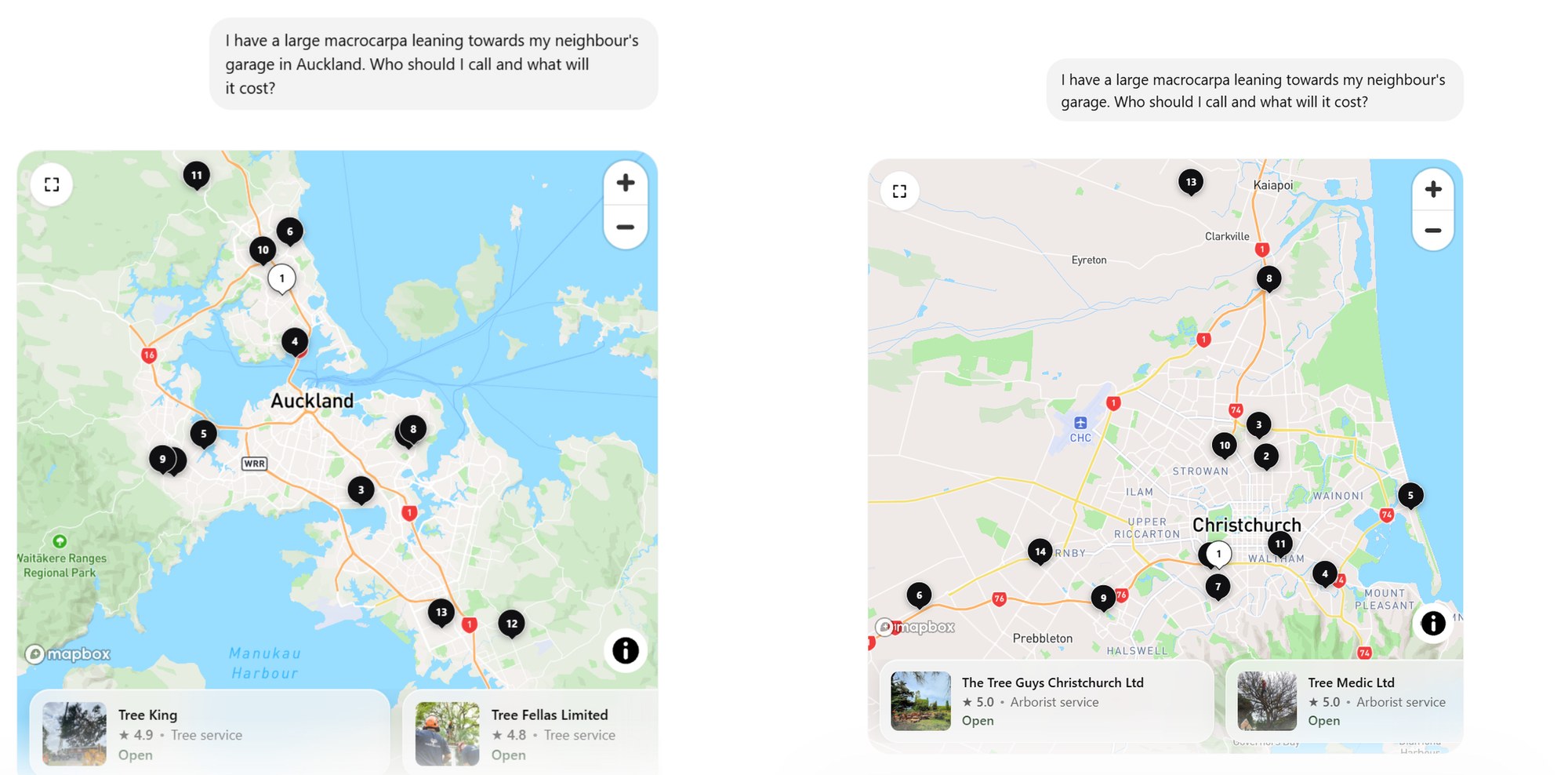
So the city you type overrides the city ChatGPT guesses, and the guess can be a hundred kilometres out. A Dunedin business can be invisible to a Dunedin buyer who never typed "Dunedin". The advice "mention your location on your website" is half right. It helps when the answer is built from web pages. When the answer is a local card, the listing data did the work.
What to do: open your Google Business Profile, your Yelp listing, and every industry directory you belong to. Make the category, description and service area on each say exactly what your site says. Agreement between listings and site is a trust signal on every pattern that uses listings.
Read the Sources panel
When ChatGPT answers with citations, the numbered markers in the text are not the full list. They overcount, because one source is often cited several times, and they undercount, because the answer draws on pages it never marks. The Sources panel, which opens from the citations button under the answer, is the best visible record of the sources ChatGPT chose to show you.
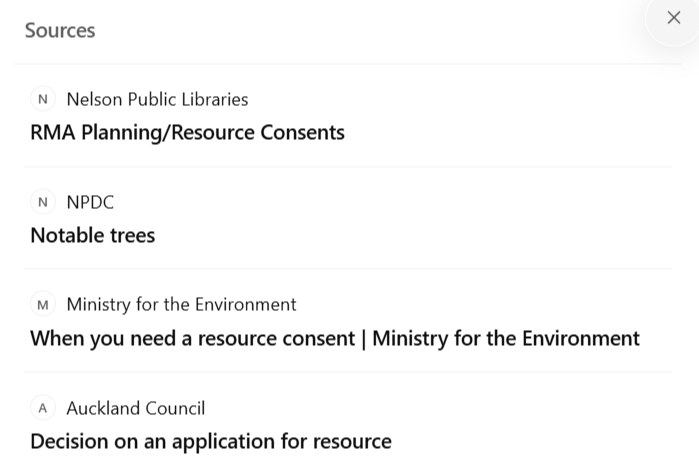
Screenshot the panel every time. Every page on it is evidence worth investigating: yours, a competitor's, or a third party ChatGPT chose to surface. Each has a different fix: improve it, outrank it, or get onto it.
Give ChatGPT something to quote
This was the most consistent finding in every category we tested. Recommended firms are described in numbers, standards and named methods, lifted straight from their own pages. "Level 5 arborist, 200 removals a year, works to the ANSI A300 pruning standard" gets repeated. "Auckland's most trusted tree care specialists" gets ignored, or the business gets filed under the wrong category because the machine had to guess.
Deana Burke's fake deodorant (above) is the same finding from the other side. Three pages of specifics about one buyer's problem got a product that does not exist recommended first. The pages were the evidence, and the machine treated them as evidence.
Do not make the machine infer the facts you want it to repeat. Your site needs some sentences where the business is the subject, the claim is concrete and the proof is attached. Not every sentence. Most of your copy should stay warm, human and written for the person reading it. But a machine that reads the whole page needs to find a handful of definitive, descriptive statements it can carry away. We have written a whole article on how to do this inside normal copywriting: The Copywriting Rule That Is Hiding You From AI.
Can the machine read your page?
Two things stop AI reading content that is right there on your site.
Text inside images
A slogan in the hero photo, a price on a banner, a tip inside a graphic. To a person that is the most prominent thing on the page. To a machine it does not exist.
Content loaded by JavaScript
Independent testing keeps finding that AI crawlers do not run scripts the way Google's does, and OpenAI does not document what OAI-SearchBot renders. If a section only appears after a script builds it (some sliders, tabs, accordions and app-style page builders work this way), assume the AI never sees it. Google runs scripts, which is why this never showed up as an SEO problem.
If a fact matters, put it in live text in the HTML. Ask your developer to confirm your key pages render without JavaScript. Ordinary PDFs are fine: a technical data sheet with real numbers in it gets read and quoted. Only PDFs that are scanned images, or sit behind a form, are invisible.
AEO myths and out-of-date advice
Everyone is testing what works, and what works changes. Something is a ranking signal in May and gone by August.
For a period, Reddit threads were everywhere in ChatGPT's Sources panels, and the advice was to get mentioned there. In mid-August 2026, visible Reddit citations in ChatGPT fell by roughly 86 percent. Then they bounced back: Ahrefs' September 2026 count put Reddit at the top of ChatGPT's most-cited websites again, with 16.8 percent of citations. Reddit is also read far more often than it is cited. The fan-out research shows ChatGPT pointing searches at specific subreddits for opinion and review questions, and Dan Petrovic measured it discarding around 99 percent of the Reddit pages it fetches. A source that can fall 86 percent in one month and return to first place the next is not something to build on. Treat Reddit as something that shapes how ChatGPT understands your category, not as a reliable way to get cited, and do not seed recommendations there: Reddit is now using its own AI models to remove around 25,000 promotional posts and comments a day.
"You need a Wikipedia page"
A claim doing the rounds at marketing conferences, and half of it is true. Wikipedia is one of the two most-cited sites in ChatGPT, alongside Reddit. Similarweb measured it at 13 percent of ChatGPT citations in January and February 2026. Ahrefs' September 2026 count put it at 7 percent, second to Reddit. The "nearly half" figure you may hear comes from an older Profound study (August 2024 to June 2025), and it is Wikipedia's share of ChatGPT's top ten sources, not of everything ChatGPT cites.
The other half is wrong for almost every New Zealand business. Wikipedia only accepts an article about a company with significant coverage in independent sources such as newspapers and books, and your own website and press releases don't count. Its conflict-of-interest rules advise anyone paid by or connected to the company not to write it, and pages created by the business are routinely deleted. Wikipedia shapes what ChatGPT knows about your category. When someone asks who to call in their town, the answer comes from your site, your reviews and your listings.
Foursquare
Foursquare started as an American app for checking in to bars and cafes. Almost nobody in New Zealand used it, but a decade of check-ins left it with a large database of business names, addresses and categories, which it now sells. When ChatGPT first needed local business data, that database was one of the places it looked, and the advice went out to claim and update your Foursquare listing. The figure you still see quoted, that 60 to 70 percent of ChatGPT local results come from Foursquare, comes from a single 50-prompt study across five Spanish cities in May 2025. A large US measurement in August 2026 put Foursquare's share between 0.00 and 0.06 percent. In between, OpenAI licensed Yelp's data on 23 July 2026. We found eight articles repeating the Foursquare figure. One kept the original study's caveat. Seven stated it as fact. Updating your Foursquare listing will not hurt you. It is not where the results come from.
"ChatGPT doesn't use Google data"
Stated as fact by one of the biggest local SEO tool vendors, repeated by Google's own AI Mode, which told us the card ratings come from Foursquare and Tripadvisor and only look like Google's because businesses keep the same scores everywhere. A third agency says the cards come from Mapbox. Three confident answers, three different sources, none tested. We checked three arborists from our test maps against their Google profiles. Every ChatGPT card matched the Google rating and the Google review count exactly, to the review. Three businesses is not proof of how the data gets there. It is proof that the confident answers are not proof either. Fix your Google profile first. On the evidence, it is what shows.
llms.txt
Google has said in writing it ignores it. You do not need one for Google's AI features.
Structured data
Not required for AI Overviews or AI Mode. It helps with clarity. It is not a gate.
Blocking GPTBot
The crawler that controls whether you appear in ChatGPT search is OAI-SearchBot. GPTBot is the training crawler, and blocking it does not affect search visibility. Check yourdomain.co.nz/robots.txt. If it blocks OAI-SearchBot, ClaudeBot or PerplexityBot, this channel is switched off for you.
Why the sources keep changing
Because OpenAI is still assembling its data pile (see above), it keeps adding and dropping sources. Foursquare was prominent in one study and absent in the next; Yelp arrived in between. The sources in the panel today are not the sources you will see in six months.
Our rule: every platform claim carries a date, and anything older than three months is unverified until rerun.
Measure your AI search visibility
Two free tools show you AI traffic you are already getting.
Bing Webmaster Tools
Free, and it has an AI Performance report (launched February 2026, expanded June 2026) showing which of your pages Microsoft Copilot cites, how often, and for which questions. Microsoft says it covers Copilot, Bing's AI summaries and selected partner integrations. It does not say ChatGPT, so do not read the numbers as ChatGPT numbers. It is still the only free, first-party view of an AI system quoting your pages. It backfills, so the day you verify you get the previous weeks too. Verify your site there even if you have never cared about Bing. We set it up for a client last week and found Copilot had been quoting their homepage a dozen times a day all winter. Nobody knew.
Microsoft Clarity
Also free. It shows sessions arriving from AI assistants as a separate channel, with recordings, so you can watch what a visitor from ChatGPT actually does on your page.
In GA4, build a channel group for referrals from chatgpt.com, perplexity.ai, claude.ai, copilot.microsoft.com and gemini.google.com. The numbers will be small. Aleyda's April 2026 analysis of 40 US sites found organic search was 108 times larger than AI referral traffic. Bing counts who cited you; Clarity and GA4 count who clicked. The gap between those two numbers is where most of the influence sits.
One more place to look. Filter your Search Console and Bing Webmaster Tools queries for anything containing site: and your domain. Thousands of impressions with almost no clicks is not people; it is machines running scoped searches against your site, and it is the closest thing to a fan-out log you can get for free.
Run it yourself in twenty minutes
- Open ChatGPT logged out, in a private window. That is the free default model, which is what more than 90 percent of ChatGPT users are on. Note which model the page shows; paid reasoning models search differently.
- Write three or four prompts the way a real buyer would, with a situation in them. Not "arborist Auckland" but: "I have a large macrocarpa leaning towards my neighbour's garage in Auckland. Who should I call and what will it cost?"
- Run each one. Screenshot the answer and the Sources panel.
- Run each one again in a fresh chat. Screenshot the differences.
- Run one prompt four ways: with the place, without the place, naming a competitor, asking a technical question. Note which pattern each produces and whether you appear.
- Ask Claude the same prompts in a clean conversation. Second engine, free, different sources.
- Read your robots.txt.
You now have a list of pages that shaped the answers, a list of patterns you are absent from, and a list of listings that disagree with your website. That is the job.
What to do about it
If you have read this far, you want to know how to get recommended. In simple terms:
- Write web copy that says plainly what you do, for whom, and where, with the numbers and specifics your customers need to know. Warm copy for people, definitive sentences for machines, on the same page.
- Get your name, address and phone number identical on every listing, and get listed where your industry is listed.
- Collect real reviews. Publish real proof. Use real numbers.
- Keep the important facts in live text, not images or scripts.
- Run the twenty-minute test above every couple of months, because the answers move.
That is most of it. It is also most of good SEO, which is why the two are closer than the hype suggests.
If it matters to you to be found in both search and AI search, and you would rather not work through this alone, talk to us. We can help you get the fundamentals right.
Accurate as of 14 October 2026. This changes weekly: new reports, new experiments, new platform deals. We re-test the claims on this page every six weeks and update the date when we do.