By Theresa Brady, founder of Creative Content. Dunedin, 30 August 2026.
I used to own a business called Better Windows. We sold window insulation film and heat pumps in Auckland, and in 2019 the homepage led with one big photo and three words across it: Come home to comfort.
That was the right call. The oldest rule in conversion copywriting says take out "we" and the company name, put in "you", and sell the outcome instead of the feature. Nobody wants a heat pump. They want to come home to a warm house. We published that rule ourselves in our 2020 guide to writing web copy, and we still stand by it.
Here is the thing I did not know then. The slogan was text inside the image. Pull the page out of the Wayback Machine today (30 March 2019 snapshot) and the slogan is not there, because a machine reading the page never saw it. What the machine saw was the rest: Penjerex film at around half the cost of double glazing, a 10 year warranty, Mitsubishi heat pumps, Unovent ventilation at 75 percent less than the alternative, testimonials from Remuera and Milford, and a Why Choose Us section.
To a person that page led with comfort. To a machine the same page was products, prices and proof, with no slogan at all. Which of those two pages a customer meets now depends on whether they found you by looking, or by asking.
What AI repeats
When ChatGPT recommends a business, it often writes a sentence with the company as the subject, a concrete claim and some evidence attached. In our tests, businesses made that job easier when those facts were stated plainly on pages the assistant could read.
We tested this on arborists (the full experiment is here). The firm ChatGPT described in most detail was described in its own words: cranes, EWP equipment, grapple excavators, specialist chippers, stump grinders, "they specifically advertise difficult and remote tree removals". Every phrase was lifted from the company's site. Firms that described the same capability as "comprehensive tree care solutions" were either skipped or filed under the wrong service.
Deana Burke proved it from the other direction. She built a fake deodorant brand for $11, three pages of specifics about magnesium versus baking soda for sensitive skin, and thirty days later ChatGPT recommended it first for exactly those questions. Her line: the model didn't lie, she did. Every claim it repeated was on her site.
Do not make the machine infer the facts you want it to repeat. Write them down.
Why good copy gets passed over
Conversion copy takes the company out of the sentence and swaps the concrete feature for the outcome the customer feels. On the page, with a human reading, that works and keeps working.
The assistant deciding whether you make the shortlist is not on the page being persuaded. It is looking for facts with your name attached, and the purer your conversion copy, the fewer it finds. "Imagine coming home to a warm, dry house" is a good sentence for a person. On its own it gives an assistant very little to use when it compares or describes the business.
The enemy is abstraction, not narrative
It is tempting to conclude that machine-readable copy has to be dry: short declarative sentences, no story, no warmth. It does not.
A case study that tells a story from start to finish can be full of sentences a machine can carry away, as long as the story is told in specifics: a 1970s brick-and-tile in Mosgiel, 140 square metres, insulated in a day, power bill down 22 percent the first winter. Story is fine. Story written in specifics quotes beautifully. What does not quote is abstraction: "innovative", "trusted", "deep expertise", "solutions". Vague narrative is unquotable. Specific narrative is not.
So the rule is not "write less warmly". It is "write in countable things".
Work out where you sit
A category everyone understands
Concrete, plumbing, electrical. Your copy is probably quotable by accident. "Coloured and decorative concrete, Christchurch, licensed, twenty years" is already a sentence an assistant can use. Check those plain facts are actually written on the page. They are often assumed rather than stated.
Something people worry about
Anything where the first question is "does that actually work". The facts are usually in your copy somewhere. They are wrapped in reassurance and need unwrapping into sentences that stand on their own. Better Windows is the example: the numbers were all there, underneath a slogan the machine could not see.
Something people do not know how to buy
Complex capability, many kinds of customer, many ways in. Your copy has the hardest job, because it has to build understanding first. Good copywriters do that with narrative. The fix is not to abandon the narrative. It is to make sure the narrative carries specifics, and that a handful of definitive sentences sit where a machine will find them.
Add a handful of sentences
Keep the persuasion. Humans still buy from humans. Then add some sentences written for the other reader, where your business is the subject and the claim comes with evidence.
Not "deep manufacturing knowledge" but "[Company] has taken more than 40 products from prototype to production, including [named product]". Not "trusted across Otago" but "[Company] has installed [the thing] in over 600 Dunedin homes since 2015". Not "peace of mind" but "every installation carries a 15 year product warranty".
Numbers, names, standards, methods. Whatever your most senior person would say to a sceptical engineer, written down.
Not every sentence. Most of your copy should stay warm and written for the person. But a machine that reads the whole page needs to find a few statements it can lift whole, and the natural home for them is a Why Choose page (we have a guide to building one), with one liftable sentence beside every capability you sell.
Put the claims in live text
Better Windows taught this one. The slogan was in the hero image, so to a machine it never existed. That was harmless, because the slogan was the least useful sentence on the page. It stops being harmless when the important claim is the one in the artwork.
Things that are usually locked inside images:
- A price on a banner
- A warranty inside a graphic
- A certification or membership badge with no alt text
- A tip or a claim in a designed tile
- Text inside a hero photo
To a person these are the most prominent things on the page. To a machine they are not there. If a fact matters, it goes in the HTML as text, and the picture can repeat it.
Where to start
Ask an assistant the question your best customer would ask, and read what comes back. If you are named, look at which of your sentences it used. If you are not, look at whose sentences it used instead, and notice the shape of them.
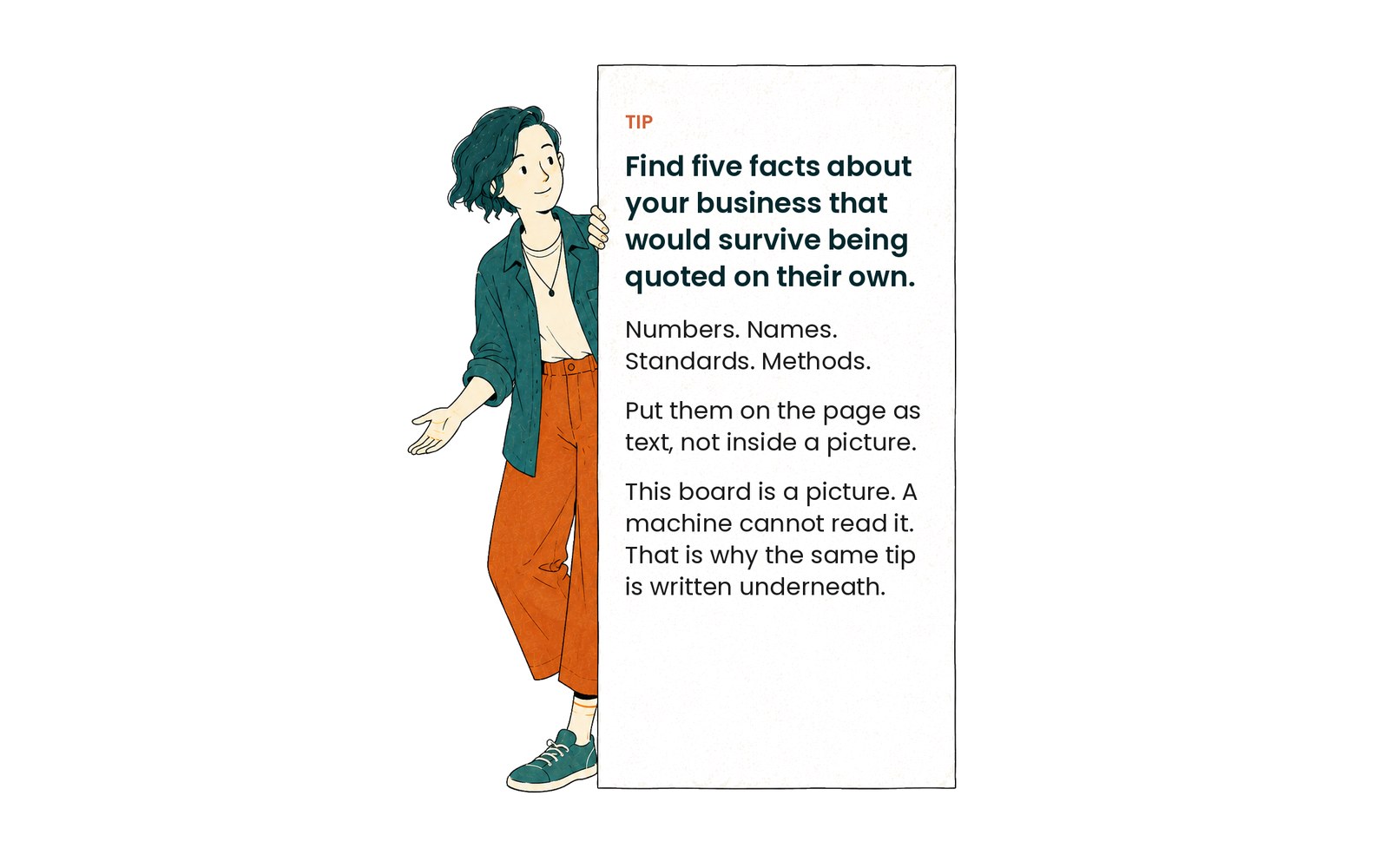
Then find five facts about your business that would survive being quoted on their own, and put them on the page in live text.
If you want help finding those five facts, that is interview work: pulling them out of the team, the customers and the job history, because most businesses cannot see their own quotable facts from the inside. Talk to us. We can help you get the fundamentals right.
Accurate as of 30 August 2026. The platforms keep changing what they read and how they read it. We run our own tests and update these guides as we learn.