
Ask an AI assistant "who should I use for a plumber in Dunedin" and it gives you names. Those names come from somewhere: the pages the assistant can read, the lists that rank, the forums where locals answer each other, the reviews on the profiles. If none of those sources mention you, the assistant cannot recommend you, no matter how good you are.
That is the whole problem in one sentence, and it reframes the work. Getting recommended by AI is not a separate dark art with its own tricks. It is being present, and quotable, in the places AI reads.
Where AI answers actually come from
For a local service question, an assistant typically draws on a short list of source types: the businesses' own websites, Google Business Profiles and their reviews, best-of and comparison lists, and public discussion, the local subreddit, community Facebook groups, trade directories. Run the test on your own category and town and read what comes back. If the sources the answer cites never mention you, you know exactly what needs to change, and it is the same list every time: your site needs to state your case in liftable sentences, your profile needs review depth, and the lists and discussions need to know you exist.
The first of those is the one entirely in your control, which is why it comes first.
The Why Choose page
Most websites imply their case. The strengths are scattered through service pages, buried in an About story, or simply assumed. Humans piece it together. AI does not, it quotes what is stated, and a claim that exists only by implication effectively does not exist.
A Why Choose page fixes that by stating the case in plain, complete, quotable sentences. It answers three questions, in words a machine could lift whole:
- What do you do, exactly? One clear paragraph, at the top: the services, the place, the kind of customer. "DesignPro is a Dunedin plumbing and gasfitting business specialising in hot water heat pump installation for homeowners" is quotable. A hero line that says "Tap into excellence" is not.
- Who is it for, and who is it not for? Naming your ideal job, and being honest about what you do not do, reads as confidence to humans and precision to machines. Assistants match specific claims to specific questions.
- Why you, in claims a competitor could not copy-paste? Upfront pricing. A named tradesperson with a stated specialty. A concrete guarantee. "Quality service" and "locally owned" describe everyone in the category and get quoted for no one.
Make the rest of the site extractable
The same principle, be liftable, applies beyond one page:
- Answer real questions in question form. An FAQ that asks what customers actually ask, "what does a hot water heat pump cost in Dunedin", "do they work in cold weather", gives an assistant a ready-made answer with your name attached.
- Keep headings honest and hierarchical. Headings that describe their sections, stepped H1 to H2 to H3, are how machines parse a page. Decorative headings and skipped levels blur it.
- Name a human. A real person with real experience on the About page gives answers someone to attribute, and attribution is currency in AI results.
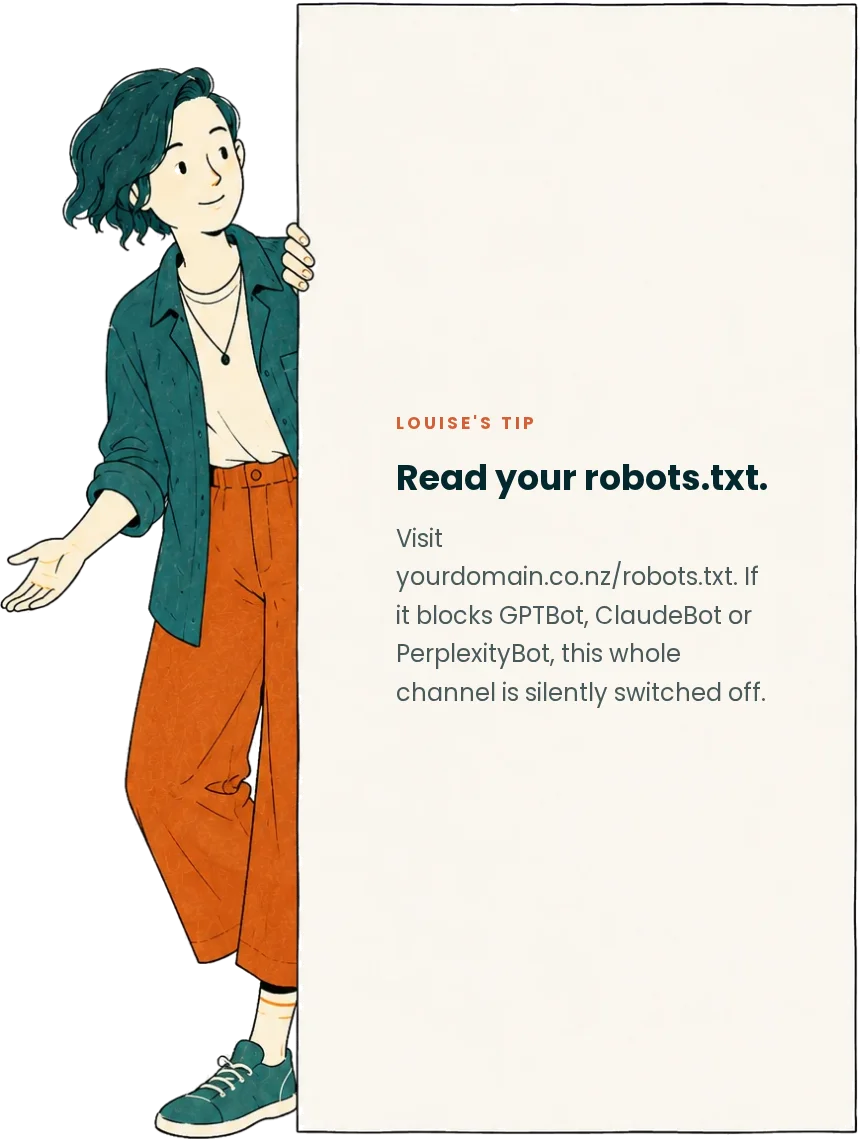
- Check you are not blocking the readers. Your robots.txt file, yourdomain.co.nz/robots.txt, should not disallow OAI-SearchBot, ClaudeBot, PerplexityBot or Google-Extended. Note that GPTBot is a different crawler and a separate decision: it is the one OpenAI uses for model training, and blocking it does not affect whether ChatGPT can find and cite you. An accidental block of the search crawlers silently switches this whole channel off.
Then earn the third-party mentions
Your own site is necessary but not sufficient, because assistants weight independent sources. The review habit from our reviews guide feeds this directly. So does being listed on the comparison sites and directories that already rank in your category, and being the business locals name when someone asks in a community group. None of that can be gamed quickly, all of it compounds.
The honest bit
The mechanics are above and they are real. The judgement, what your quotable difference actually is, which claims to lead with, how far to go before the effort outruns the return in a small market, is the part we charge for. Most businesses cannot see their own difference from the inside; drawing it out is half the job.

Where to start
The free local visibility audit includes the AI tests: what the assistants say today when asked about your category in your town, who they name instead of you, and exactly why. From there, the fix list writes itself. Get in touch to request your audit.
Related guides: How Google Business Profile Categories Actually Work · How to Get More Google Reviews, the Steady Way · Describing Your Services for Local SEO: Website First
Last reviewed 29 August 2026. AI and local search are changing quickly, and the platforms keep changing what they read and how they read it. We run our own tests and update these guides as we learn. If something here no longer matches what you are seeing, tell us.