If your business relies on Meta ads for leads, you've probably felt it. Campaigns that used to hum along quietly got harder. Costs crept up for no reason you could see. Ads that worked for years stopped working, and nothing in Ads Manager explained why. You weren't imagining it, and it wasn't something you did wrong. Meta rebuilt its entire advertising engine underneath you, and until a few weeks ago, nobody outside Meta knew exactly how the new one worked.
That changed at Meta's annual Performance Marketing Summit, where the company laid out, in unusual detail, exactly how its new AI advertising system decides which ads to show, to whom, and when.
This matters because it turns years of guesswork into an actual playbook. It answers questions I have carried through hundreds of campaigns. And it confirms that the way we build campaigns needs to change, not at the account-settings level, but at the creative and messaging level.
Here's the story of how we got here, what Meta revealed, and what it means for your campaigns going forward.
The golden age: when targeting was the game
If you ran Meta ads in the 2010s, you remember the levers. Detailed interest targeting. Custom audiences. Lookalikes built from your best customers. Layered exclusions. Placement controls. If you became proficient, you could understand your audience deeply, build a smart audience structure, and pull as many levers as you liked. Skill in the platform translated directly into performance, and the advertisers who mastered the machinery won.
The whole model rested on one thing: data flowing freely. Meta could see what people did across the internet, and advertisers could act on it with precision.
Then the data dried up, and Andromeda arrived
Privacy changes, most famously Apple's iOS tracking restrictions, cut off much of that signal. Meta's response was not to patch the old system. It rebuilt the entire advertising engine around artificial intelligence, starting with a system called Andromeda in late 2024.
Andromeda flipped the logic. Instead of starting with the audience you defined and finding ads for them, it starts with your ad, reads the creative itself, the imagery, the video, the audio, the words, and works out who it is for. Your targeting settings became a suggestion. The creative became the targeting.
For New Zealand advertisers, the transition was genuinely hard. These AI systems learn from volume, and our audiences are micro on the scale Meta's models were built for. A national campaign here can be smaller than a single suburb's campaign in the United States. We saw real performance drops while the system recalibrated, and recovering that performance took restructured accounts, consolidated campaigns, and a different approach to creative. Most of that recovery work is now behind us. What was missing was certainty about why it worked.
What Meta just revealed: the machine has five parts
The Summit changed that. Meta walked advertisers through the full stack of AI systems that now decide every impression, and it published the performance lift each one delivered. In plain English:
Andromeda is the scout

Running on new AI hardware Meta built with NVIDIA, it scans the tens of millions of ads in the system and narrows them to a shortlist of the most relevant few thousand for each individual person, based on what your creative actually shows and says. Every visually distinct piece of creative gets its own identity in the system and its own path to being retrieved, which is why a diverse creative library now literally earns more reach. Meta measured an 8 percent lift in ad quality after Andromeda rolled out.
GEM is the brain

Meta's largest ads model, trained across thousands of GPUs at the same scale as the big language models. It blends what your creative contains, what format it's in, and how people behave, and it predicts the entire sequence of actions a person takes before and after seeing an ad. It knows the difference between someone idly dreaming and someone ready to buy, and it teaches every other model in the stack what it learns. GEM delivered a 5 percent conversion lift in its initial rollout on Reels and now runs platform-wide.
Lattice is the ranker

Meta used to run separate models for separate jobs: one for lead campaigns, one for purchases, one for Feed, one for Reels, dozens more behind the curtain, each learning alone. Lattice collapsed them into one system that learns across every objective and placement at once, so a lesson from a lead campaign on Instagram now improves a conversion campaign on Facebook. Meta attributes roughly a 12 percent improvement in ad quality and up to a 6 percent increase in conversions to it, and it keeps compounding: the most recent Lattice update posted double-digit gains in Meta's own testing this year.
Sequence Learning is the storyline
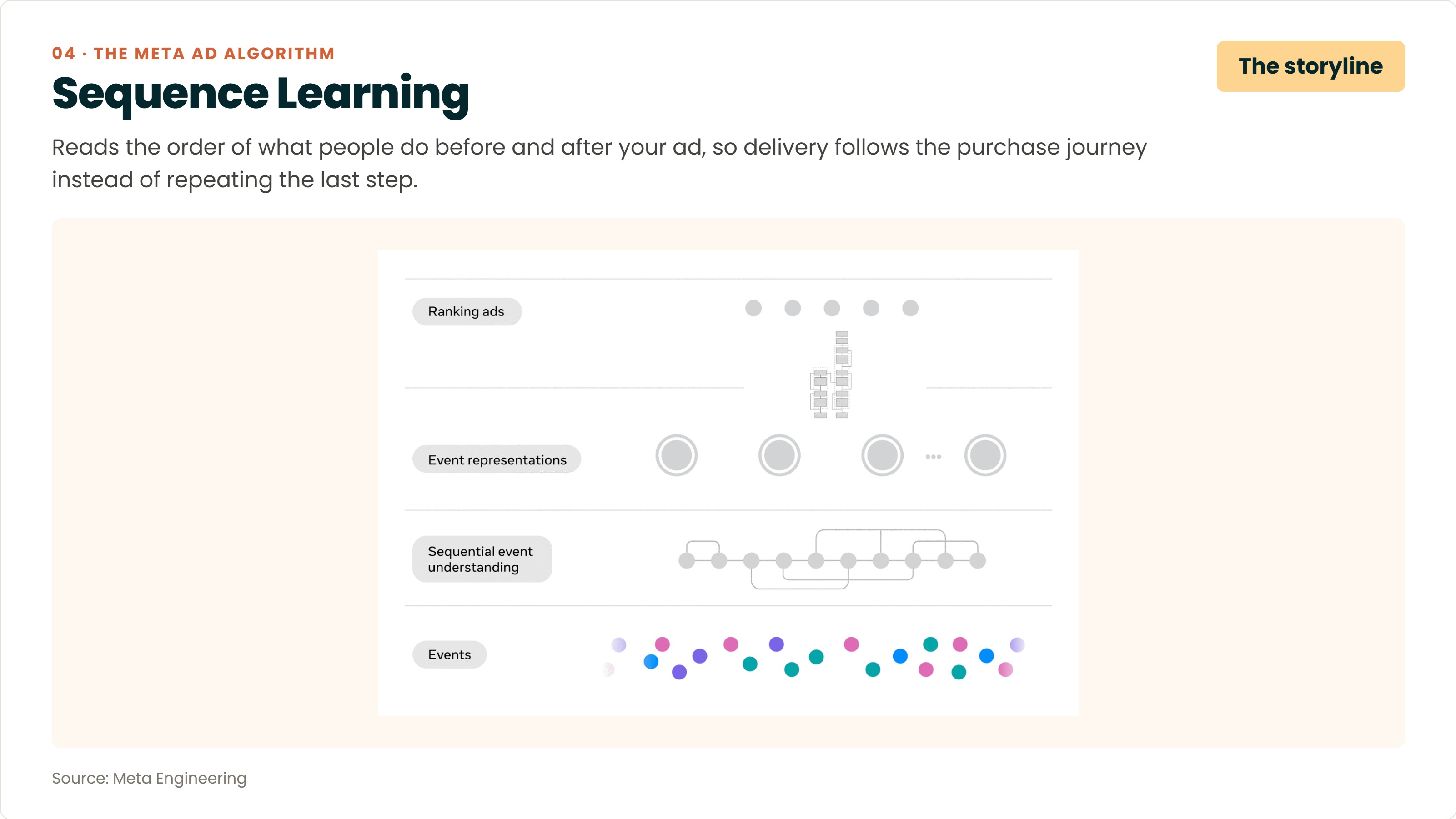
Older systems thought in isolated events: you clicked a thing, so here's more of that thing. It's why booking one weekend away used to mean being chased around the internet by hotel ads for a trip you'd already booked. Sequence Learning reads the order of what people do, so after the booking it moves on with you: the gear, the extras, the next need in the journey rather than the last one repeated. Early testing showed a 3 percent conversion lift, and this approach only grows in importance as privacy rules shrink the signals advertisers can hand over.
The Adaptive Ranking Model is the newest piece
It uses longer interaction histories to make delivery decisions in real time. It is also the reason the seven-day learning period is now a hard rule, not a suggestion. The system needs uninterrupted time to observe and calibrate.
Together, these systems move a person through a journey. Meta is no longer showing ads. It is sequencing them.
What this means: the work has moved
Here is the practical upshot, and it is good news dressed as more work.
For an ad campaign to succeed under this system, especially a lead generation campaign running more than a couple of weeks, three things need to be in place before launch.
Creative diversity. The system needs a genuine mixture of asset types: single images, carousels, short videos, longer videos. Each distinct piece of creative gives the AI another pathway to reach a different kind of person. One hero video, however good, is one pathway.
Journey-stage messaging. Because the system sequences people, it needs messages built for every stage: the dreamer who is years away, the person actively comparing options, the one with a single unresolved objection. The AI can only serve the right message at the right moment if that message exists.
Sound structure. Those creatives and messages then need to be organised correctly inside the account: broad rather than micro-targeted, consolidated enough for the AI to learn quickly, all placements open so the system can find your people wherever they are.
And underneath all three sits one condition: patience. Ads need enough budget to gather roughly fifty conversion signals in a week, and they need to run untouched for at least seven days. Every mid-flight edit resets the learning. The single most damaging thing you can do to a live campaign is fiddle with it daily.
The part I find genuinely exciting
Look at that list again. Creative variety. Messages matched to stages of a customer journey. Meeting people where they are, more than once, in more than one way.
That is not a new discipline. That is content marketing. Meta has effectively formalised, inside its ad system, the thing good marketers have always done outside it. The strategy has not changed; it has been written into the algorithm.
What changes is where the effort goes. Setting up a campaign used to mean hours inside Ads Manager pulling targeting levers. Now the account setup is the easy part, and the real work happens before launch: planning the creative set, writing the messaging for each stage, and building enough assets to give the system what it needs. Campaigns will take longer to set up. They will also be built on clearer ground than we have ever had, because for the first time, we are not guessing at the rules.
For our clients, there is nothing you need to do. This is our domain, and it is exactly the work we have been quietly moving toward. From here, every campaign we build will be structured for the way Meta actually works: full creative coverage, every stage of the journey, and the discipline to let the machine learn.
The black box is open. Now we build for it. If you'd like to talk about what this shift means for your own campaigns, get in touch.