
Here is a pattern we see constantly in local audits: a business with a perfect 5.0 rating and 19 reviews, invisible behind competitors with 4.4 stars and three hundred. The rating is lovely, but it is not the whole story.
Reviews do three jobs at once. Google says the number of reviews and positive ratings can help a business show up in local results. They are the proof a customer reads before calling. And increasingly they are the raw material AI assistants draw on when someone asks "who should I use for X in my town". A thin review count quietly loses you all three.
The good news is that review volume is the most fixable gap in local search, because it responds to nothing more sophisticated than asking. The trick is making the ask a habit rather than a campaign.
Why steady beats bursts
Twenty reviews arriving in one week, then nothing for six months, looks odd to Google and does little for you. Two or three arriving every month, indefinitely, compounds. Recency matters as well as volume: a profile whose newest review is eight months old reads as a business that has gone quiet, to Google and to customers alike.
So the goal is not a review drive. It is a permanent, boring, reliable step at the end of every job.
Build the ask into how jobs finish
The businesses that accumulate reviews do the same three things:
- Ask at the moment the job is done. The best time is at handover, at final payment, when the problem is visibly fixed. Not a week later by email, when the job has faded from memory.
- Make it one tap. Google gives every profile a direct review link, find it in your profile dashboard under "Ask for reviews". Put that link in a text template, a follow-up email, and a QR code on the invoice. Nobody searches for your business to review it; they tap or they do not.
- Give the job to a person. "We should ask for reviews" belongs to nobody. "Hannah sends the review text when she sends the invoice" happens every time.
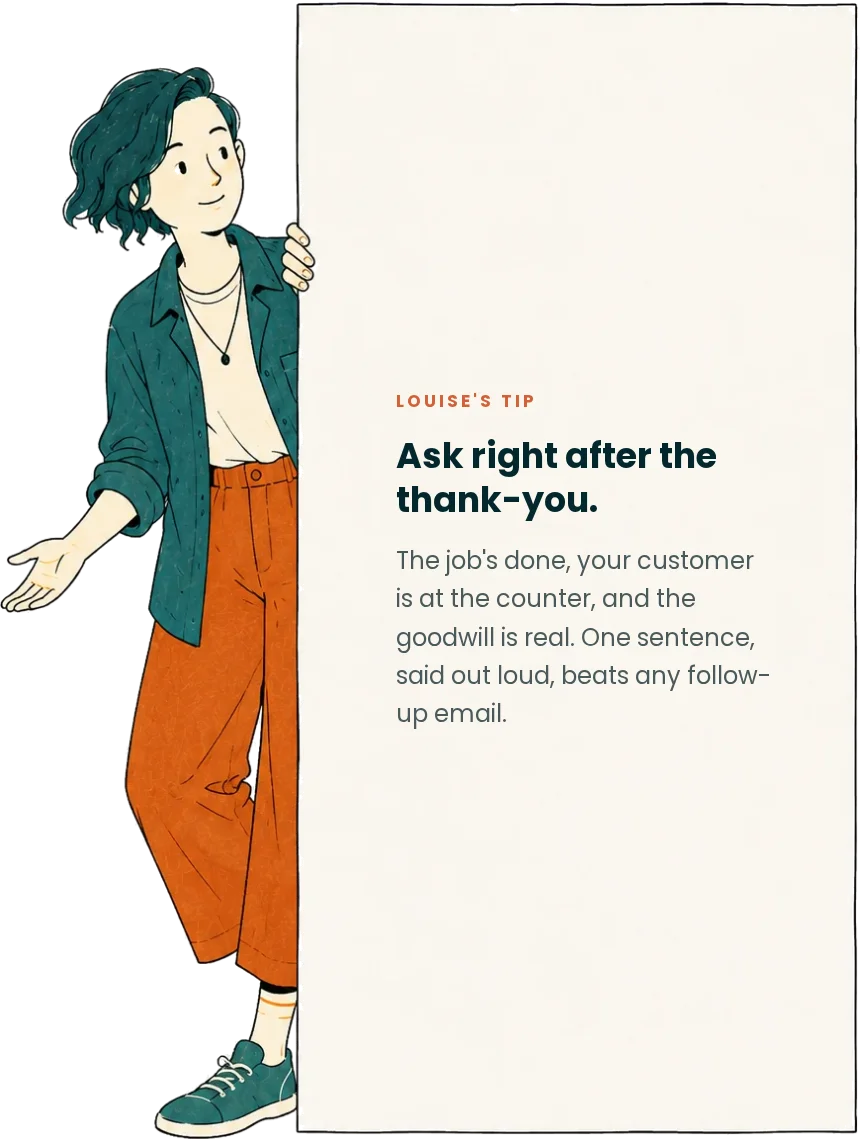
Send the same invitation to every customer, not only the ones you think were happy. A wording that works, because it is honest and small: "Thanks again for choosing us. If you'd like to share how the job went, we'd appreciate an honest Google review. Here is the link."
Let customers say it in their own words
A review that describes the job and the result reassures the next customer far more than "great service". But you cannot script that, and Google's rules say you should not try: you can ask for a review, but not ask people to include particular content. Ask while the job is fresh, and customers will describe what you did on their own. Put your service names where the wording is yours: your Google profile's services and description, and your website.
Reply to every review
Responses are part of the same system. They signal to Google that the profile is actively managed, and they show the next reader that you are the kind of business that answers. Reply to the old ones too, a short thank-you months later costs nothing and completes the picture.
Negative reviews get the same treatment, calm, factual, and brief. One graceful reply to a bad review does more for a wary reader than ten five-star ratings.
What not to do
Do not buy reviews, trade discounts for them, or have family pad the count. Google's detection is better than people assume, and a filtered or suspended profile costs far more than a thin one. Do not tell customers what to write, what rating to give or which service or staff member to mention. And do not review-gate, asking only customers you know are happy while steering others to a private form. It breaches Google's rules and it shows.
The honest bit
The mechanics here are genuinely the whole method, and it is all doable in-house. The judgement is in the details: what your particular customers respond to, how the ask fits your job flow without feeling grabby, and what to do when a profile has a problem review or a filtering issue. That assessment is the paid part. The method is free.

Where to start
Our free local visibility audit benchmarks your review count and rating against the three businesses actually outranking you, so you know exactly how big the gap is and how fast a steady ask would close it. Request your free audit.
Related guides: How Google Business Profile Categories Actually Work · Describing Your Services for Local SEO: Website First · How to Get Found by AI Search